
A manlift is only as safe as the checks carried out before it is used: not once at the start of a rental, but before every shift. This guide provides a pre-use checklist, explains how periodic inspections work, and walks through what a risk assessment should cover before work begins.
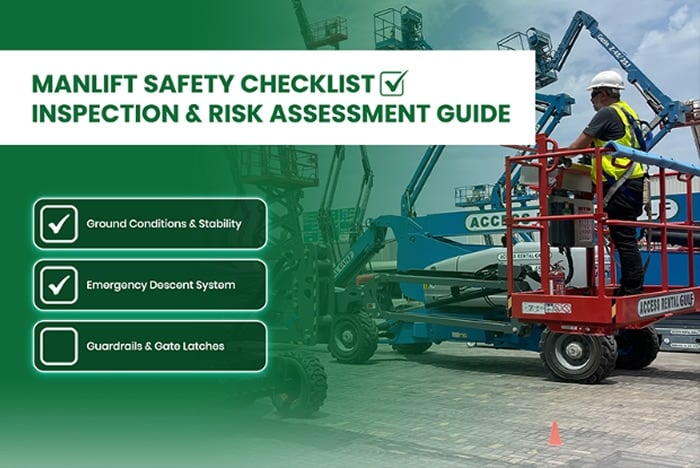
For a broader overview of manlift safety topics, see our pillar guide: The Complete Guide to Manlifts.
Skipping pre-use checks, even on a short job, removes one of the main ways problems are caught before they become incidents. Always follow the manufacturer’s instructions for the specific machine, together with the rules of your site and local regulations.
Daily Pre-Use Manlift Safety Checklist
| # | Checklist Item | What To Check |
| 1 | Visual inspection | Boom, platform and chassis for visible damage, cracks or wear |
| 2 | Hydraulic system | Hoses and cylinders for leaks or visible damage |
| 3 | Controls test | All controls, including emergency stop and emergency descent |
| 4 | Guardrails and gates | Secure, undamaged and functioning correctly |
| 5 | Tyres and outriggers | Tyre condition; outrigger operation and deployment where fitted |
| 6 | Ground and work area | Firm, level enough for the machine and free of overhead hazards |
| 7 | Fall protection | Harness and lanyard fitted and anchored correctly where the machine, site or employer requires them |
| 8 | Rated capacity | Combined weight of people, tools and materials within the rated limit |
| 9 | Battery or fuel | Enough charge or fuel for the planned work |
| 10 | Decals and documentation | Load charts and safety decals present, legible and matching the machine |
How Often Does a Manlift Need a Full Inspection?
Beyond the daily pre-use check, powered access machines are subject to periodic inspection. The intervals, and who must carry them out, vary by jurisdiction, by the manufacturer’s maintenance schedule and by the standard that applies, so treat the figures below as examples rather than universal rules.
- Pre-use check: carried out by the operator before every shift, using a checklist like the one above.
- Frequent or periodic inspection: many manufacturer and standards-based schedules call for a more detailed mechanical review at set intervals (often quarterly), and after incidents, modifications, or extended storage.
- Annual or thorough examination: a comprehensive inspection by a competent person. In some countries, the required interval for equipment that lifts people is shorter than twelve months.
Requirements in the UAE, Saudi Arabia, Qatar and Bahrain can differ by authority, emirate or project, and some projects set their own rules. Confirm the applicable requirement with the relevant authority, your main contractor or your safety adviser.
For rented equipment, the rental provider normally maintains the machine and holds its inspection records, but you should still confirm the machine’s current inspection status before a long-term rental, particularly where a mid-project inspection could disrupt the job. For certification, see manlift operator training and certification.
Carrying Out a Manlift Risk Assessment
A risk assessment is different from the daily checklist. It is a documented review of the site, task, and conditions carried out before work begins, aimed at identifying and controlling hazards for that particular job rather than checking the machine’s general condition. A manlift risk assessment should typically cover:
| Risk Factor | Potential Hazard | Control Measure |
| Ground conditions | Machine instability or tipping | Check ground strength, slope and surface before positioning |
| Overhead obstacles | Collision with structures or cables | Survey the working area before operation |
| Weather conditions | Wind affecting stability | Follow the manufacturer’s limit; see our manlift wind speed limits guide |
| Load capacity | Platform overload | Do not exceed rated capacity |
| Operator training | Incorrect machine operation | Use trained and authorised operators |
| Electrical hazards | Contact with power lines | Maintain safe clearance distances |
| Site traffic | Contact with power lines | Maintain safe clearance distances |
Risk assessments should be documented, reviewed by a competent person, and clearly communicated to the operator and ground personnel before work begins. They should be revisited when site conditions change rather than filed once and forgotten.
Common Factors Behind Manlift Incidents
Incident guidance from industry bodies and regulators commonly points to a recurring set of contributing factors rather than a single cause: skipped or rushed pre-use checks, overloading the platform, inadequate ground assessment, working too close to overhead hazards and operating without suitable training. Each of these can be reduced by a consistent checklist, a project-specific risk assessment and trained operators.
Who Is Responsible for Inspection and Risk Assessment?
| Person or Organisation | Typical Responsibility |
| Operator | Completing daily checks, operating safely and reporting issues |
| Supervisor | Confirming safe working conditions and correct equipment use |
| Employer or contractor | Providing training, PPE and safe systems of work |
| Rental company | Providing maintained equipment and inspection records |
| Safety officer | Monitoring compliance and risk controls |
Responsibility is usually shared rather than held by one person, but the exact legal duties differ by country, regulator and contract. In general, the operator carries out the daily checks, a competent person such as a supervisor or safety officer reviews and signs off the risk assessment, and the rental provider maintains the machine and its periodic inspection records. Ground personnel play a supporting role by watching for hazards the operator cannot see from the platform and knowing how to respond in an emergency. Confirm who holds each duty in your contract and under the rules that apply to your site.
FAQs
What should be checked on a manlift before every shift?
The daily checklist should cover visual inspection, the hydraulic system, controls, guardrails, tyres and outriggers, ground conditions, fall protection where required, and confirmation that rated capacity will not be exceeded.
How often does a manlift need a full inspection beyond the daily check?
It varies by jurisdiction, manufacturer schedule, and applicable standard. Many schedules include a more detailed periodic inspection (often quarterly) and an annual or thorough examination, but confirm the requirement for your location and project.
What is the difference between a pre-use checklist and a risk assessment?
A pre-use checklist reviews the machine’s condition before each shift. A risk assessment is a documented review of the site, task, and conditions for that specific job.
What should a manlift risk assessment cover?
Ground conditions, overhead hazards, weather exposure, proximity to other site activity, emergency procedures, and any task-specific hazards.
Who is responsible for carrying out a manlift risk assessment?
A competent person, often a site supervisor or safety officer, normally reviews and signs it off with input from the operator and ground team. Legal responsibility depends on local regulations and the contract.
What are common contributing factors in manlift incidents?
Skipped or rushed pre-use checks, overloading, poor ground assessment, working near overhead hazards, and inadequate training are all commonly cited.
Does the rental company handle periodic inspections, or is that my responsibility?
A rental provider normally maintains the machine and holds inspection records, but you should confirm the machine’s inspection status before a long-term rental.
What role do ground personnel play in manlift safety?
They keep the area clear, watch for hazards the operator cannot see, and should know how to use ground-level emergency controls where the machine allows.
Should a risk assessment be repeated if site conditions change?
Yes. Review and update it whenever conditions change meaningfully, rather than treating it as a one-time document.
Can Access Rental Gulf provide safety documentation with equipment rental?
We can provide safety guidance and machine documentation with our manlift rental services across the UAE, Saudi Arabia, Qatar, and Bahrain. Project-specific risk assessments remain the responsibility of the employer or contractor.
Contact Us
Website: Access Rental Gulf
Email: marketing@accessrental-gulf.com
UAE: +971 4340 4573
Saudi Arabia: +966 1380 81527
Bahrain: +973 1784 0787
Qatar: +974 4039 9522