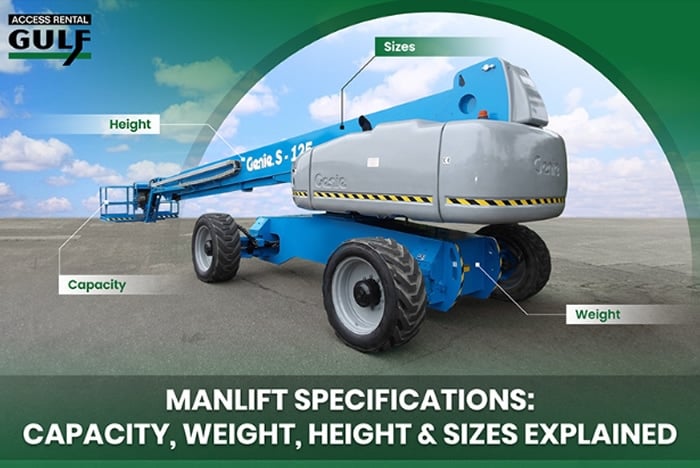
Manlift spec sheets look straightforward until you need to match one to a real job. At that point, terms such as “working height”, “rated capacity” and “unladen weight” matter far more than they first appear to. This guide explains what each specification means and how to use it to choose the right size of manlift.
For the full category overview, see our pillar guide: The Complete Guide to Manlifts.
Platform Height vs Working Height
These two figures are often confused, and the difference can change which machine is appropriate for a job.
- Platform height is the height of the platform floor above ground level.
- Working height is the highest point an operator can realistically work at from the platform. Manufacturers generally calculate it by adding an allowance for operator reach to the platform height, but the exact definition and the size of that allowance depend on the manufacturer and model.
When a brief says “we need to reach 15 metres”, it matters whether that means platform height or working height, because the difference can change which machine is needed. As a rough guide, the gap is often around two metres, but this is not a universal formula. Always confirm which figure a quoted specification refers to, and check the manufacturer’s data sheet for the model.
Typical Height Ranges by Manlift Type
| Manlift Type | Platform Height (General Guidance) | Capacity Range (General Guidance) | Ideal Applications |
| Vertical mast lift | Roughly 4 to 12 m | Roughly 120 to 230 kg | Indoor maintenance, electrical work, warehouses, retail |
| Scissor lift | Roughly 6 to 18 m | Roughly 230 to 450 kg or more | Construction, ceiling installation, industrial maintenance |
| Articulated boom lift | Roughly 10 to 28 m or more | Roughly 230 to 450 kg | Reaching over obstacles, outdoor construction, building maintenance |
| Telescopic boom lift | Roughly 12 to 40 m or more | Roughly 230 to 450 kg | High-rise projects, bridges, steel structures, large commercial sites |
| Truck-mounted manlift | Roughly 12 to 30 m | Roughly 200 to 450 kg | Roadside maintenance, utility work, quick deployment |
These ranges are general industry guidance, not a description of any specific fleet, and individual models fall outside them. Access Rental Gulf’s fleet literature cites working heights of up to around 43 metres across its range, but the exact height, capacity and dimensions of a given machine should always be confirmed from its data sheet before you book.
Rated Capacity: What It Includes
A manlift’s rated capacity is the maximum combined weight the platform is permitted to carry. It covers everything on the platform, not just the operator’s body weight:
- The operator, or operators on platforms rated for more than one person
- All tools carried onto the platform
- Materials being moved or installed
- Any additional equipment, such as welding gear or fixtures being fitted
Capacities range from around 230 kg on smaller platforms to 450 kg or more on heavy-duty boom and scissor models, depending on the model. Exceeding rated capacity, even briefly, can compromise the machine’s stability and is a recognised overloading hazard, so it should never be treated as spare capacity.
Machine Weight: Why It Matters Beyond Job Height
Machine weight is often the most overlooked specification, yet it affects where a manlift can be used:
- Suspended floors and upper storeys: check machine weight against the floor’s load rating before positioning, especially on structures under construction or renovation.
- Rooftop work: roof structures have load limits that the machine’s weight plus rated capacity must not exceed.
- Soft or unfinished ground: heavier machines need firmer ground to avoid sinking or tipping. Tracked machines can suit this kind of ground, and we cover them in our guide to Haulotte, Nifty, Snorkel & Crawler manlifts.
- Lift and doorway access: for indoor jobs, weight and dimensions determine whether a given lift or freight elevator can carry the machine.
Matching Manlift Size to Your Project
Work through three specification checks, in this order:
- Confirm working height, not just structure height. Allow for the difference between platform height and working height for the model you are considering.
- Confirm rated capacity covers your actual combined load. Operator plus tools plus materials, not body weight alone.
- Confirm the machine’s weight and dimensions suit the work surface and access route. This matters most for indoor, rooftop, and upper-floor work.
Skipping any of these checks is a common way to end up with a machine that does not fit the job, even when the height figure alone looks right on paper.
Key Specifications Checklist Before Rental
| Specification | What It Means | Why It Matters |
| Platform height | Height of the raised platform floor above ground | Shows whether the machine can physically reach the work area |
| Working height | Practical maximum height at which the operator can work, as defined by the manufacturer | Ensures the operator can reach the highest work point |
| Rated capacity | Maximum combined load of people, tools and materials | Prevents overloading and protects stability |
| Machine weight | Weight of the machine without load | Determines suitability for floors, roofs, lifts and ground |
| Platform dimensions | Working space inside the platform | Confirms people, tools and materials fit |
| Ground conditions | Strength and evenness of the surface | Helps prevent stability problems on soft or uneven ground |
Getting Specification Guidance for Your Job
Spec sheets give baseline figures, but matching them to a real job, especially one with layered constraints such as limited floor loading and a specific working height, is where experienced guidance helps. Our team can review your height, capacity, and site constraints together rather than checking each figure in isolation. Browse our manlift rental range or contact us to discuss your requirements.
FAQs
What is the difference between platform height and working height?
Platform height is the height of the platform floor. Working height is the highest point the operator can realistically work at, as defined by the manufacturer, and is usually higher than platform height by an allowance for operator reach.
What is the maximum height a manlift can reach?
It depends on the model. Large telescopic booms reach considerably higher than compact categories such as vertical mast lifts, which are generally much lower. Check the data sheet for the specific machine.
What weight can a manlift platform carry?
Rated capacities vary by model, from around 230 kg on smaller platforms to 450 kg or more on heavy-duty machines. The rating covers workers, tools, and materials combined.
Does rated capacity include tools and materials?
Yes. It covers everything on the platform, not just the operator’s weight.
Why does a manlift’s own weight matter?
Machine weight determines where it can safely operate, including suspended floors, rooftops, and soft ground, regardless of whether height and capacity match the job.
What size manlift do I need for indoor work through a standard doorway?
Compact machines such as vertical mast lifts and some narrow scissor lifts are commonly used where access is restricted. Check the machine’s width against the narrowest point on the route.
How much taller is working height than platform height?
The gap depends on the manufacturer’s definition and the machine. It is often around two metres, but confirm it from the data sheet rather than assuming.
Can I exceed rated capacity briefly if the extra weight is temporary?
No. The rated capacity is a limit, and exceeding it, even briefly, can compromise stability.
What height range is typical for a scissor lift versus a telescopic boom?
Scissor lifts commonly offer platform heights of roughly 6 to 18 metres, while telescopic booms commonly range from around 12 metres to 40 metres or more, depending on the model.
Where can I find the height and capacity for the machine I am renting?
On the manufacturer’s data sheet and the machine’s data plate. Your rental provider can confirm the specifications of the specific unit before delivery.
Contact Us
Website: Access Rental Gulf
Email: marketing@accessrental-gulf.com
UAE: +971 4340 4573
Saudi Arabia: +966 1380 81527
Bahrain: +973 1784 0787
Qatar: +974 4039 9522