Mobile Elevating Work Platforms (MEWPs) provide a safe and efficient way to carry out work at height when the correct equipment, planning and operating procedures are followed. Across the United Arab Emirates (UAE), Saudi Arabia, Bahrain and Qatar, MEWPs are widely used for construction, maintenance, MEP installation, inspection and other work-at-height applications.
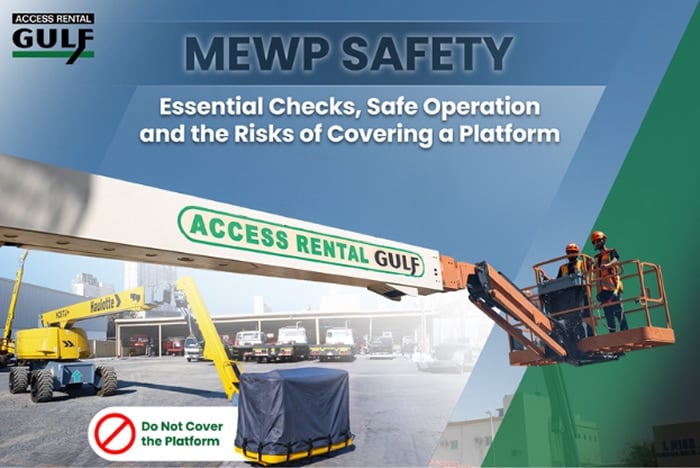
However, safe MEWP operation involves much more than simply getting the machine to the required working height. From completing pre-use inspections and checking ground and weather conditions to understanding machine limitations and avoiding unauthorised attachments, every stage of the operation can affect safety.
This is particularly important during hot and windy conditions, when operators may consider using a tarpaulin, banner, shade or other temporary cover around the platform. What may appear to be a simple solution can introduce additional hazards and affect the way a MEWP performs.
At Access Rental Gulf (ARG), safety is an important part of our powered access services. We provide MEWP and powered access solutions across the GCC, including the UAE, Saudi Arabia, Bahrain and Qatar, alongside IPAF-approved operator training to help operators develop the knowledge and practical skills required for safer powered access operations.
Why Is MEWP Safety Important?
MEWPs are designed to provide controlled access to elevated work areas, but they must be operated within the manufacturer's specified limits.
A safe operation starts before the machine is switched on. Operators should understand the equipment they are using, inspect the machine and work area, identify potential hazards and confirm that environmental conditions are suitable.
Good MEWP safety practices can help reduce the risk of:
- Falls from height
- Machine instability
- Collision with people, structures or other equipment
- Overturning
- Entrapment and crushing
- Contact with overhead hazards
- Equipment damage
- Operator error
- Unsafe loading or attachments
Proper training is also essential. ARG provides IPAF operator training covering powered access equipment categories including mobile vertical and mobile boom platforms, helping operators understand safe operation, machine controls, limitations and emergency procedures.
Essential MEWP Pre-Operation Checks
Before operating a MEWP, the operator should complete the required pre-use inspection and function checks in accordance with the manufacturer's instructions and site procedures.
Important areas to consider include:
1. Inspect the Machine
Check the MEWP for visible damage, leaks, missing components or other defects that could affect safe operation.
Pay particular attention to:
- Tyres and wheels
- Guardrails and gates
- Platform condition
- Hydraulic components
- Emergency systems
- Warning devices
- Harness and anchorage arrangements where applicable
- Controls and switches
- Structural components
Any defect that could affect safe operation should be reported and dealt with before the machine is used.
2. Test the Controls
Operators should make sure that the controls and safety functions operate correctly before starting work.
This includes checking the relevant drive, steering, lifting and lowering functions, emergency controls and other machine-specific safety systems.
Operators should never assume that a machine is safe simply because it was operating correctly on a previous shift.
3. Inspect the Work Area
The surrounding environment is just as important as the condition of the machine.
Operators should identify potential hazards such as:
- Uneven or unstable ground
- Slopes
- Excavations
- Overhead structures
- Power lines
- Other vehicles and machinery
- Pedestrians
- Restricted access areas
- Falling-object risks
- Wind and adverse weather
Where required, suitable exclusion zones and a MEWP spotter should be used to help manage risks and improve communication.
4. Wear the Correct PPE
The required PPE will depend on the machine, task and site risk assessment.
Where required, operators should use suitable fall protection equipment and connect it correctly to the designated anchorage point.
PPE should never be considered a replacement for proper planning, training and safe operating procedures.
Can You Cover a MEWP Platform?
One important safety question is whether a MEWP platform can be covered with a tarpaulin, banner, shade, advertising material or another temporary attachment.
The answer depends on the specific machine, manufacturer instructions, attachment and operating conditions.
A cover or attachment should never be added simply because it appears harmless or because it has been used on another machine.
An unauthorised cover can change the characteristics of the platform and introduce hazards that were not present when the machine was designed and tested.
Before adding any attachment, operators and site managers should consult the manufacturer's instructions and confirm that the proposed arrangement is specifically permitted.
How Can a Cover Increase Wind Load?
Wind is an important consideration when operating a MEWP.
A platform without an additional cover has a defined configuration and wind rating specified by the manufacturer. Adding a large surface such as a tarpaulin, banner, or temporary screen can increase the area exposed to wind.
This can create additional forces on the elevated platform and machine.
The risk may become greater when:
- The platform is raised to a significant height
- Wind speeds increase
- The attachment creates a large surface area
- The cover is not designed or approved for the machine
- The machine is being operated outside its specified conditions
Even a lightweight material can behave differently when exposed to strong or gusting wind.
For this reason, operators should always check the manufacturer's requirements and the prevailing weather conditions before and during operation.
Other Risks of Covering a MEWP Platform
In addition to wind load, an unauthorised cover or temporary attachment can introduce several other hazards.
- Restricted Visibility
A banner, sheet or temporary screen can obstruct the operator's view.
Reduced visibility can make it more difficult to identify:
- People around the machine
- Structures
- Overhead obstacles
- Other equipment
- Changes in the work area
Where visibility is restricted, appropriate controls such as a trained MEWP spotter may be required.
- Restricted Emergency Access
A poorly positioned cover or attachment could interfere with access to the platform or emergency controls.
Operators must be able to respond quickly if an emergency occurs.
Any attachment that restricts access to controls, gates, escape routes or emergency systems should not be used unless it has been specifically approved by the manufacturer.
- Trip and Entanglement Hazards
Loose sheets, ropes, straps, cables or other temporary materials can create trip and entanglement hazards.
Materials can also become displaced during movement or in windy conditions.
The platform should always remain clear and organised so operators can move safely and maintain access to controls.
- Interference with Controls
Temporary materials should never interfere with machine controls.
Controls must remain accessible and function as intended. An attachment that catches on a control, restricts operator movement or prevents an operator from reaching an emergency control can create a serious safety risk.
- Additional Loading
Any additional equipment, materials or attachments can change the load on the platform.
Operators must stay within the machine's rated platform capacity and follow the manufacturer's requirements for personnel, tools and materials.
Never assume that an additional attachment is acceptable simply because its weight appears small.
Never Make Unauthorised Modifications
MEWPs are engineered and tested for specific operating conditions.
Making an unauthorised modification or attaching equipment that has not been approved by the manufacturer can change the machine's operating characteristics.
This can include:
- Temporary covers
- Banners
- Screens
- Shade structures
- Additional frames
- Unapproved tools or equipment
- Other temporary attachments
If an attachment is required for a particular application, the operator or site management team should first establish whether it is approved for that specific machine.
If it is not authorised, do not use it.
Following the manufacturer's instructions is one of the most important principles of safe MEWP operation.
Check Weather and Wind Conditions
Weather conditions should form part of the MEWP risk assessment before work starts.
Operators should consider:
- Wind speed
- Gusting conditions
- Rain
- Poor visibility
- Extreme temperatures
- Lightning or storms
- Changing weather conditions during the task
The manufacturer's maximum permitted wind speed and operating conditions should always be followed.
Importantly, conditions can change during a job. A machine that was safe to operate when work started may no longer be suitable if wind or weather conditions deteriorate.
If conditions become unsafe, stop work and lower the platform when it is safe to do so.
Why MEWP Operator Training Matters
Safe equipment operation depends on competent and properly trained operators.
IPAF training helps operators develop the knowledge and practical skills required to operate powered access equipment safely and effectively.
Access Rental Gulf is an IPAF Approved Training Centre, providing operator training for powered access equipment. Its training covers areas such as safe machine operation, pre-use inspection, function testing and emergency procedures. Successful candidates can receive an IPAF PAL Card and operator logbook.
ARG's training includes categories such as:
- 3A – Mobile Vertical: including mobile scissor lifts
- 3B – Mobile Boom: including self-propelled boom lifts
- 1A – Static Vertical
- 1B – Static Boom: including relevant static and vehicle-mounted platforms
Training can be delivered at ARG's premises or, subject to suitable facilities and PPE, at the customer's site.
The Importance of a Strong Safety Culture
MEWP safety is not the responsibility of the operator alone.
Employers, supervisors, site managers, equipment providers and operators all have a role to play in creating a safe working environment.
A strong safety culture means:
Plan it. Check it. Operate it safely.
Before work starts, make sure the correct MEWP has been selected for the task and that operators understand its capabilities and limitations.
During the operation, continue monitoring the machine, work area and weather conditions.
If something changes and the operation is no longer safe, stop and reassess the situation.
MEWP Safety Checklist
Before operating a MEWP, consider the following:
| Safety Check | What To Consider |
| Machine Inspection | Check for damage, defects, leaks and missing components |
| Controls | Test operating and emergency controls |
| Work area | Identify ground, overhead, traffic and pedestrian hazards |
| Weather | Check wind and other weather conditions |
| Platform capacity | Stay within the manufacturer's rated capacity |
| PPE | Wear the required PPE and fall protection where applicable |
| Attachments | Do not use unauthorised modifications or attachments |
| Visibility | Make sure the operator has adequate visibility |
| Exclusion zone | Keep people away from the operating area |
| Training | Use trained and authorised operators |
| Emergency procedures | Understand emergency lowering and site rescue procedures |
| Changing conditions | Stop work if conditions become unsafe |
Choose Safety Over Assumptions
A tarpaulin, banner or temporary cover may look like a simple way to provide shade or protection while working at height. However, adding anything to a MEWP can have consequences for wind exposure, stability, visibility, loading and emergency access.
The safest approach is to follow the manufacturer's instructions and never make assumptions about what is acceptable.
Similarly, a pre-use inspection should never be treated as a routine tick-box exercise. Operators should actively look for hazards and understand the equipment they are operating.
When it comes to MEWP safety, plan the work, check the equipment and environment, and stop if conditions become unsafe.
MEWP Hire and IPAF Training Across the GCC
Access Rental Gulf provides powered access solutions across the Gulf Cooperation Council (GCC), serving customers in the United Arab Emirates, Saudi Arabia, Bahrain and Qatar. ARG offers access equipment including scissor lifts, articulating boom lifts and telescopic boom lifts, alongside machine sales and IPAF training services.
Whether you need powered access equipment for construction, MEP work, inspection, painting, electrical installation or other work-at-height applications, selecting the right machine and ensuring operators are properly trained are essential parts of safe project planning.
Contact Access Rental Gulf
Email: marketing@accessrental-gulf.com
UAE: +971 4340 4573
Saudi Arabia: +966 1380 81527
Bahrain: +973 1784 0787
Qatar: +974 4039 9522
For MEWP hire, powered access equipment, machine sales or IPAF operator training across the UAE, Saudi Arabia, Bahrain and Qatar, contact Access Rental Gulf to discuss your requirements.
Frequently Asked Questions About MEWP Safety
FAQs
What is a MEWP?
A Mobile Elevating Work Platform (MEWP) is a type of powered access equipment designed to safely lift people to elevated working positions. Common examples include scissor lifts, boom lifts and other access platforms used for work at height.
Can you cover a MEWP platform with a tarpaulin or banner?
You should not add a tarpaulin, banner, shade or other temporary attachment to a MEWP unless it is specifically permitted by the machine manufacturer. An unauthorised cover can increase wind exposure, affect stability, restrict visibility and create additional safety hazards.
Why can covering a MEWP platform increase the risk of instability?
A cover can create a larger surface area for wind to act against. This may increase wind forces on the elevated platform and affect the machine's stability. Operators should always follow the manufacturer's specified wind limits and operating instructions.
What checks should be completed before operating a MEWP?
A pre-use inspection should include checking the machine for visible damage or defects, inspecting the platform and guardrails, checking controls and safety systems, and testing the relevant functions. The operator should also inspect the work area and identify ground, overhead, traffic and weather-related hazards.
What PPE is required when operating a MEWP?
The required PPE depends on the machine, task and site risk assessment. Depending on the application, this may include safety footwear, a hard hat, high-visibility clothing and suitable fall protection equipment. Operators should follow the site's PPE requirements and the manufacturer's instructions.
Can an operator use a MEWP during strong winds?
Only when weather conditions remain within the manufacturer's specified operating limits. Wind speeds and conditions should be checked before and during operation. If conditions become unsafe or exceed the permitted limits, work should stop.
Why is MEWP operator training important?
Proper training helps operators understand the equipment, controls, operating limitations, pre-use inspection requirements and emergency procedures. Competent operators are better prepared to identify hazards and operate the machine safely.
Does IPAF training cover MEWP safety?
Yes. IPAF operator training covers important aspects of powered access operation, including equipment familiarisation, pre-use checks, safe operation and emergency procedures. Access Rental Gulf is an IPAF Approved Training Centre providing powered access training across the GCC.
Can I add a temporary attachment to a MEWP?
Do not add an attachment, frame, banner, screen, cover or other modification unless it has been approved for use with the specific machine by the manufacturer or otherwise meets the applicable requirements. Unauthorised modifications can affect loading, stability, controls and safe operation.
What should an operator do if MEWP conditions become unsafe?
The operator should stop work and follow the appropriate site and manufacturer's procedures. If weather conditions deteriorate, visibility becomes restricted, a fault develops, or another hazard makes continued operation unsafe, the task should be reassessed before work resumes.