Working safely and efficiently at height is one of the biggest challenges faced by construction sites, warehouses, ports, and maintenance teams across the Gulf region. Whether you are painting the exterior of a high-rise tower in Dubai, carrying out MEP work in Riyadh, inspecting a dock crane in Doha, or maintaining warehouse racking in Manama, a boom lift is very often the safest and fastest way to get your team where they need to be.
This pillar guide is your one-stop resource on boom lifts, what they are, how they work, the different types available, how they compare to scissor lifts and cherry pickers, and how to rent or buy the right machine anywhere in the UAE, Saudi Arabia, Qatar, and Bahrain. As a company that has operated across the GCC since 2007, Access Rental Gulf (ARG), the Middle Eastern division of UK-based AFI Rentals, has supplied and supported thousands of boom lift projects across the region, and this guide draws on that first-hand experience.
What Is a Boom Lift?
A boom lift, sometimes called an aerial boom lift or boom man lift, is a type of Mobile Elevating Work Platform (MEWP) used to lift one or more workers, along with their tools and materials, to an elevated work position. Unlike a simple ladder or scaffold, a boom lift gives operators a stable, enclosed platform with guardrails, controls, and, depending on the model, significant horizontal outreach as well as vertical height.
A boom lift is made up of a chassis (the base, which may be wheeled, tracked, or truck-mounted), a boom arm (which can be telescopic, articulating, or a combination of both), and a platform at the end of the boom where the operator stands. The operator controls the machine from the platform itself, raising, lowering, extending, rotating, and driving the unit as needed.
Boom lifts are widely used across construction, maintenance, inspection, painting, electrical installation, warehousing, event production, and industrial sectors throughout the GCC because they combine height, reach, and mobility in a single piece of boom lifting equipment.
Boom Lift vs Scissor Lift: What’s the Difference?
People frequently search for “boom lift and scissor lift” or “scissor lift boom lift” together because both are types of MEWPs used for working at height, but they are built for very different jobs.
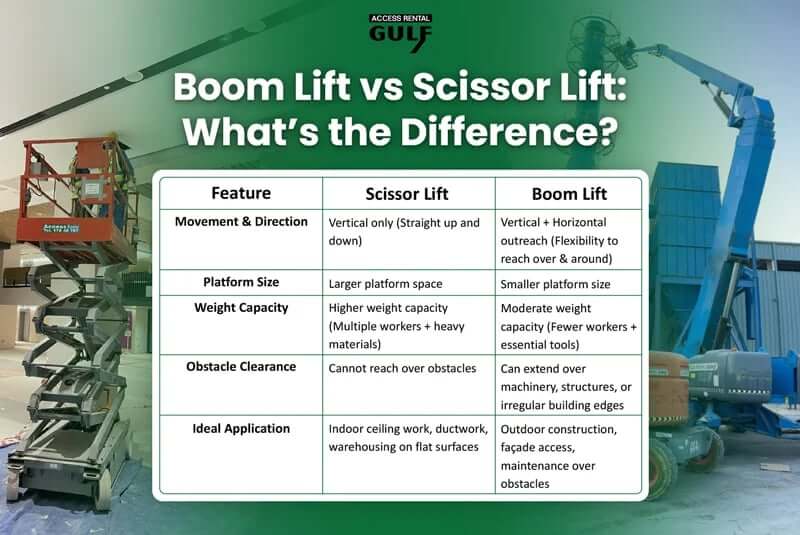
A scissor lift moves straight up and down on a criss-crossing (scissor) mechanism. It offers a larger platform and higher weight capacity, which is ideal when several workers or heavy materials need to go up together. Still, it cannot reach outward or around obstacles.
A boom lift, on the other hand, can extend both vertically and horizontally, and many models can also rotate the platform, allowing operators to reach over obstacles, around structures, or up and across a building façade. This makes a boom scissor lift comparison really a question of “straight-up reach with a bigger platform” versus “height plus outreach with a smaller platform.”
If your job involves working directly overhead on a flat area, such as indoor ceiling work, a scissor lift is usually more efficient. If your job requires reaching over machinery, water, landscaping, or an irregular building edge, a boom lift is almost always the better choice.
Types of Boom Lifts
There are several distinct categories of boom lifts, each suited to different site conditions, reach requirements, and terrains.
Telescopic Boom Lifts
A telescopic boom lift, also called a “stick boom,” extends outward in a straight line like a fishing rod, giving operators the longest horizontal outreach of any MEWP category. These machines are the go-to choice when you need to reach far out and up, over an obstacle, across a rooftop, or up the side of a tall structure, without needing to bend the boom around anything.
Articulating Boom Lifts
An articulating boom lift has multiple jointed sections that can bend and flex, similar to a human arm. This “up-and-over” capability makes articulating booms perfect for navigating around obstacles such as pipework, structural beams, trees, or existing equipment, situations where a straight telescopic reach will not work.
Electric and Diesel Boom Lifts
Boom lifts are also categorised by power source. Electric boom lifts are quieter, produce zero on-site emissions, and are typically used indoors or in emission-sensitive environments such as shopping malls, airports, or hospitals. Diesel boom lifts offer more power and are built for rough outdoor terrain, larger construction sites, and industrial yards where extended run-time and rugged performance matter more than noise or emissions.
Crawler and Compact Boom Lifts
For sites with limited access, soft ground, or delicate flooring, such as inside a completed building, compact and crawler-track boom lifts provide height and reach with a much smaller footprint and reduced ground pressure than a standard wheeled unit.
Truck-Mounted Boom Lifts (Cherry Pickers)
A cherry picker boom lift is generally a truck-mounted or trailer-mounted platform used for utility work, tree trimming, and street-level maintenance. The “cherry picker vs boom lift” question usually comes down to mobility: a cherry picker is designed to be driven between multiple job sites on public roads. In contrast, a self-propelled boom lift is designed to move around within a single work site.
We cover the differences between telescopic and articulating booms, and cherry pickers versus self-propelled boom lifts, in much greater depth in our dedicated comparison guide: Types of Boom Lifts: Telescopic vs Articulating vs Cherry Picker.
Leading Boom Lift Brands: JLG, Genie & Skyjack
Not all boom lifts are built to the same standard. Across the GCC, the market is dominated by three globally trusted manufacturers:
● JLG: known for robust engineering and a wide range of telescopic and articulating models suited to heavy industrial and construction use.
● Genie: a favorite for its reliability, ease of maintenance, and popular articulating models used across warehousing, maintenance, and construction projects.
● Skyjack: recognized for straightforward, durable designs that keep downtime low on demanding sites.
Access Rental Gulf supplies, rents, and sells machines from all three of these manufacturers, giving customers across the UAE, Saudi Arabia, Qatar, and Bahrain a genuine choice of the right MEWP boom lift for their project rather than being limited to a single brand.
Boom Lift Height, Reach & Capacity
One of the most common questions we receive is about boom lift maximum height. Boom lifts on the market today range from small, compact units capable of roughly 10–15 metres of platform height, right up to some of the largest boom lift models in the industry, which can exceed 40–50 metres, enough to reach the upper floors of a mid-rise tower without scaffolding.
Choosing the right size is not just about maximum height. You also need to consider:
● Horizontal outreach: how far the platform needs to extend sideways from the base.
● Platform capacity: how much weight (workers, tools, materials) the platform needs to carry safely.
● Ground conditions: whether the site is flat concrete, uneven ground, or soft soil, which affects whether you need a rough-terrain or a smooth-floor model.
● Access width: how narrow the gaps or doorways are that the machine needs to pass through to reach the work area.
A small boom lift is often the right choice for tight indoor spaces or narrow yards, while large diesel telescopic units are better suited to open construction sites with long, unobstructed reach requirements. Our team routinely helps customers work through exactly this sizing decision as part of every rental or purchase enquiry.
Renting vs Buying a Boom Lift
Whether it makes more sense to rent or buy depends heavily on how often you will use the equipment.
Boom lift rental is usually the smarter choice when: You want to avoid maintenance, storage, transport, and depreciation costs. Your project needs different boom sizes or types at different stages. You want access to the newest, best-maintained machines without capital outlay.
Buying a boom lift tends to make more sense when: You have consistent, long-term, in-house use for the equipment. You have the facilities and trained staff to store, service, and transport the machine. You plan to build a rental fleet of your own.
Access Rental Gulf supports both needs, providing flexible buying and rental of access platforms. Our fleet is available for short- and long-term boom lift hire across the UAE, Saudi Arabia, Qatar, and Bahrain, and our ARG Resale division also sells new and inspected used machines to companies that are ready to own their equipment outright. You can read our detailed rental breakdown here: Boom Lift Rental Services Across UAE, Dubai, Sharjah & the GCC, or explore purchase options here: Boom Lift for Sale in UAE, Qatar, Saudi Arabia & Bahrain.
Common Uses of Boom Lifts Across the GCC
Boom lifts are used across almost every industry that involves working at height. Common applications across our UAE, Bahrain, Qatar, and Saudi projects include:
● Construction and building: Façade work, structural steel, glazing, and general access during the build phase.
● MEP installation: Mechanical, electrical, and plumbing work in commercial and industrial buildings.
● Painting and finishing: Exterior painting of towers, warehouses, and industrial facilities.
● Inspection and maintenance: Bridges, tanks, cranes, and structural steelwork.
● Dock and port work: Servicing cranes, gantries, and loading equipment at ports across the Gulf.
● Electrical installation: Street lighting, overhead cabling, and substation maintenance.
● Warehousing and logistics: High-level racking installation, signage, and facility maintenance.
● Airports and media productions: Specialized access for signage, lighting rigs, and event installations.
You can explore how boom lifts are used in each of these sectors in more depth on our Sectors.
Boom Lift Safety, Certification & Training
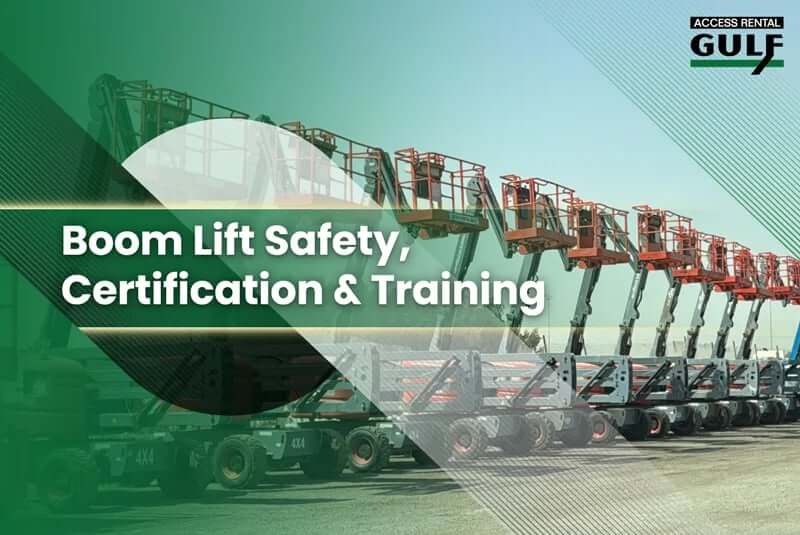
Working at height carries real risk, and boom lifts must always be operated by trained, certified personnel. IPAF (International Powered Access Federation) training and a valid boom lift operator license are the industry standard across the GCC, and every operator should complete a boom lift risk assessment and safety checklist before starting work.
Access Rental Gulf operates a licensed IPAF training centre, and successful trainees receive an IPAF PAL Card valid for two years. If you want a full breakdown of certification requirements, common hazards, and daily safety checklists, read our dedicated guide: Boom Lift Safety, Training & Certification Guide.
Specifications, Parts & Maintenance
Every project brief is different, so understanding boom lift specs, platform height, outreach, capacity, weight, and dimensions is essential before choosing a machine. Regular servicing of parts such as the hydraulic cylinder, battery (for electric models), and platform controls keeps machines safe and minimises downtime. Our technical breakdown of boom lift parts names, dimensions, and maintenance schedules is available here: Boom Lift Specifications, Parts & Technical Guide.
How to Choose Between a Boom Lift and Other MEWPs
| Feature | Scissor Lift | Articulating Boom Lift | Telescopic Boom Lift | Truck-Mounted (Cherry Picker) |
| Primary Motion | Straight Up & Down | Up & Over (Flexible) | Straight Line Outreach | Mobile / Road-Driveable |
| Horizontal Reach | None | High (Around Obstacles) | Maximum (Straight Distance) | Moderate to High |
| Platform Capacity | Heavy (Multiple Workers + Tools) | Moderate | Moderate | Moderate |
| Best Ground Condition | Flat, Solid Surfaces | Rough / Smooth Terrain | Rough / Smooth Terrain | Paved Roads / Firm Ground |
| Ideal For | Indoor Ceiling & Racking Work | Complex MEP & Obstructed Sites | High-Reach Structural & Façade Work | Multi-Site Utility & Street Work |
Before committing to a boom lift, it is worth confirming that it is genuinely the best tool for the job compared with other MEWPs. Ask yourself:
● Do I need horizontal outreach, or just straight vertical height? If it’s purely vertical and the floor area is flat and open, a scissor lift may be simpler and more cost-effective.
● Is the work area obstructed? If pipework, structures, or equipment stand between the machine and the work position, an articulating boom lift is usually the answer.
● Is the job spread across multiple locations in a single day? A cherry picker-style truck-mounted unit may be more efficient than repositioning a self-propelled boom lift repeatedly.
● What is the ground like? Soft, uneven, or sensitive flooring may call for a compact, crawler, or lighter electric unit rather than a large diesel machine.
● How many workers and how much material need to go up together? Higher-capacity requirements may favour a scissor lift or a larger boom platform.
Getting this assessment right at the planning stage avoids costly delays, machine swaps, or safety compromises once work is already underway.
How Boom Lift Rental Companies Support Your Project
A good boom lift supplier does more than deliver a machine to site. Across the GCC, the best rental and sales partners typically provide:
● Pre-project consultation: Helping you select the right height, reach, and power type before you commit.
● Fast, reliable delivery and collection: Minimising downtime between project phases.
● Operator training and certification support: So your team is compliant before work begins.
● Ongoing technical support: Troubleshooting and maintenance throughout the rental period.
● Genuine parts and manufacturer-standard servicing: Whether the machine is rented or purchased.
● Multi-country coverage: A single point of contact if your projects span the UAE, Saudi Arabia, Qatar, and Bahrain.
This kind of full-service support is particularly valuable for contractors managing multiple sites simultaneously, where consistency of equipment quality and service standards across locations makes a real difference to project timelines.
Boom Lifts on Construction Sites: Practical Considerations
On active boom lift construction sites, planning equipment logistics alongside the rest of the programme avoids costly delays. Key practical considerations include:
● Site access: Confirming gate widths, ramps, and turning circles can accommodate the chosen machine’s dimensions.
● Overhead clearance: Checking for cranes, scaffolding, power lines, and other structures that could restrict boom movement.
● Sequencing: Coordinating boom lift use around other trades and equipment to avoid site congestion.
● Ground protection: Using mats or plating where a heavier diesel unit could otherwise damage finished surfaces or soft ground.
● Refuelling or charging logistics: Planning diesel refuelling or electric charging points, particularly for multi-day or multi-shift use.
Discussing these details with your rental or sales partner before the machine arrives on site significantly reduces the risk of delays once work is underway.
Environmental & Site-Specific Factors in the GCC
The Gulf’s climate and site conditions bring their own considerations for boom lift use. High summer temperatures can affect battery performance on electric models and increase the importance of regular hydraulic fluid checks on diesel units. Sandy or dusty environments require more frequent filter and component inspection to prevent premature wear. Coastal and port environments, common across the UAE, Bahrain, and Qatar, also increase the importance of corrosion checks on exposed metal components. Our regional maintenance teams factor these conditions into every service schedule across the machines we rent and sell.
Why Choose Access Rental Gulf
Access Rental Gulf has been active in the Middle East access equipment industry since 2007, operating as the regional division of UK-based AFI Rentals. We currently serve customers across the UAE, Saudi Arabia, Qatar, and Bahrain with:
● A large, well-maintained fleet of telescopic and articulating boom lifts from JLG, Genie, and Skyjack.
● Short-term and long-term boom lift rental across all four countries.
● New and used boom lifts for sale, supported by our ARG Resale team.
● A licensed IPAF training centre offering full operator certification.
● Local depots and support teams in each country we serve, so help is always close by.
Whether you need a single small boom lift for two days of maintenance work or a fleet of large telescopic units for a multi-month construction programme, our team can help you choose, size, and mobilize the right machine quickly.
Get in Touch
Ready to hire or buy a boom lift anywhere in the Gulf? Our regional team is on hand to help.
● Website: Access Rental Gulf
● Email: marketing@accessrental-gulf.com
● UAE: +971 4340 4573
● Saudi Arabia: +966 1380 81527
● Bahrain: +973 1784 0787
● Qatar: +974 4039 9522
FAQs
What is a boom lift used for?
A boom lift is used to safely lift workers, tools, and materials to an elevated work position, giving both height and horizontal outreach for tasks such as construction, maintenance, painting, and inspection.
What is the difference between a boom lift and a scissor lift?
A scissor lift only moves straight up and down and offers a larger platform, while a boom lift can extend outward and often rotate, making it better for reaching over obstacles or across uneven areas.
What is the maximum height of a boom lift?
Boom lift maximum height ranges from around 10 metres on small compact units to over 40–50 metres on the largest telescopic models, depending on the manufacturer and model.
Is a cherry picker the same as a boom lift?
A cherry picker is generally a truck-mounted boom platform designed for road travel between sites, while a self-propelled boom lift is designed to move around within a single job site. Both use a boom arm to lift workers.
What is an articulating boom lift best used for?
An articulating boom lift is best used when you need to reach up and over obstacles such as pipework, structures, or equipment, thanks to its multiple jointed, flexible boom sections.
What is a telescopic boom lift best used for?
A telescopic boom lift is best used when you need maximum horizontal outreach in a straight line, such as reaching across a rooftop or over a wide obstacle.
Do I need a license to operate a boom lift in the UAE or GCC?
Yes. Operators should hold valid IPAF certification or an equivalent recognized boom lift operator license before operating a boom lift on any commercial site across the UAE, Saudi Arabia, Qatar, or Bahrain.
Should I rent or buy a boom lift?
If you need the machine for a short-term or single project, renting is usually more cost-effective. If you have ongoing, long-term, in-house use, buying may offer better long-term value.
Which boom lift brands does Access Rental Gulf supply?
Access Rental Gulf supplies, rents, and sells boom lifts from JLG, Genie, and Skyjack, three of the most trusted MEWP manufacturers in the world.
Does Access Rental Gulf operate across the whole GCC?
Yes. Access Rental Gulf operates depots and support teams across the UAE, Saudi Arabia, Qatar, and Bahrain, offering boom lift rental, sales, and IPAF training in each country.