
Choosing the right access equipment starts with understanding the different types of boom lifts available and what each is actually designed to do. This guide compares telescopic boom lifts, articulating boom lifts, and cherry pickers, and explains the difference between boom lift construction and boom lift operation for each type so that you can select the right machine for your project across the UAE, Saudi Arabia, Qatar, or Bahrain.
For a full introduction to boom lifts, start with our pillar guide: The Complete Guide to Boom Lifts.
Telescopic Boom Lift: Straight-Line Reach
A telescopic boom lift extends outward in a straight line, section by section, similar to how a fishing rod or car antenna extends. This design gives telescopic booms the longest horizontal outreach of any MEWP category, making them the preferred choice when a job requires reaching far up and out without needing to bend around anything in the way.
Best suited for: Reaching across open areas such as rooftops, water features, or landscaped zones. Construction sites where maximum straight-line reach is the priority, jobs where the work area is a known, fixed distance from where the machine can be positioned.
Articulating Boom Lift: Flexible, Up-and-Over Reach
An articulating boom lift has multiple jointed boom sections that bend, much like an elbow and shoulder, allowing the platform to move up, over, and around obstacles. This flexibility is what separates it from a telescopic unit.
Best suited for: Navigating around pipework, structural beams, ductwork, or existing equipment. Indoor maintenance work in tight, obstacle-filled spaces—jobs where the straight-line path to the work area is blocked.
Articulating Boom Lift vs Telescopic: Key Differences
The core articulating boom lift vs telescopic decision comes down to the nature of your site and the specific task:
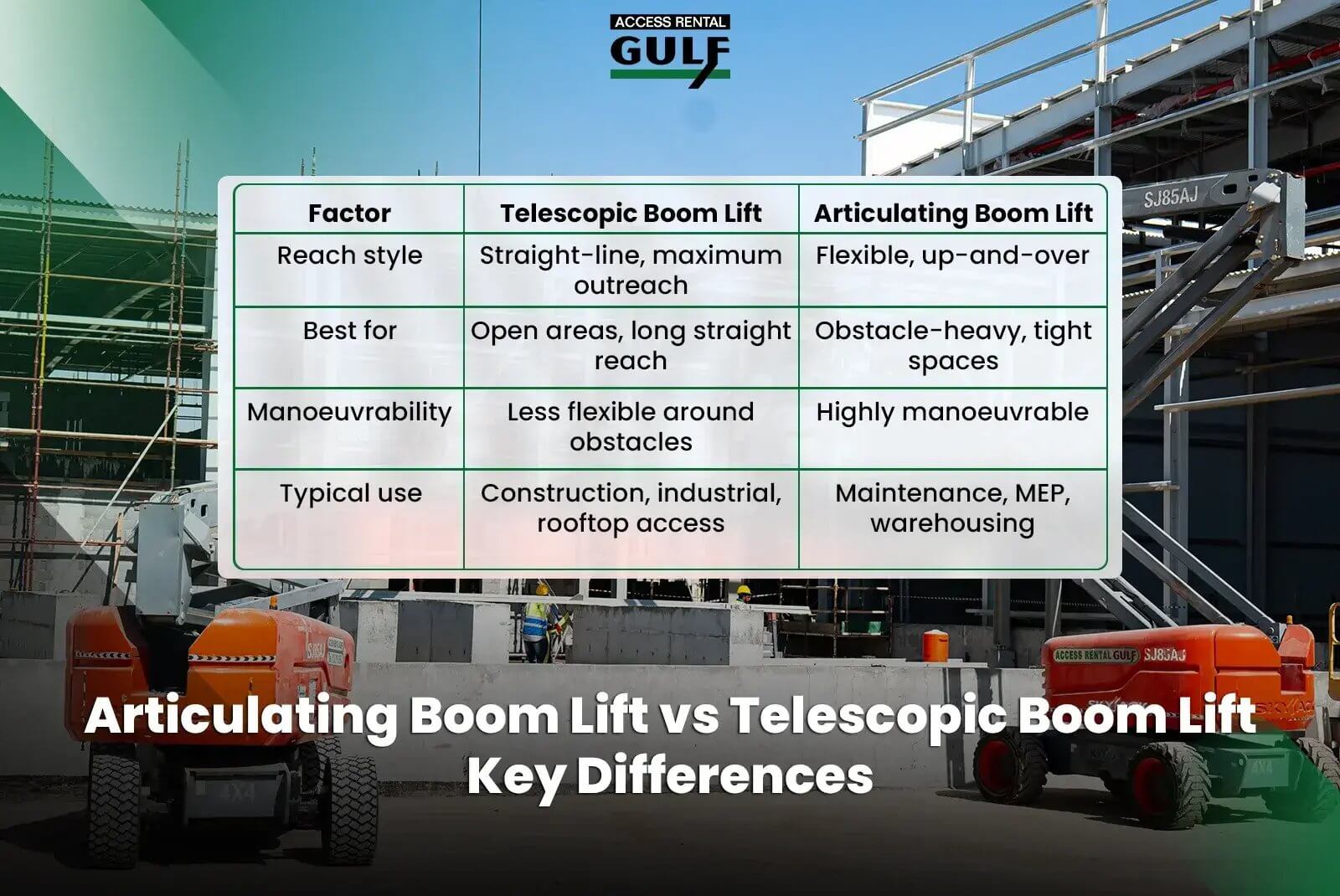
In many cases, the deciding factor is simple: if there is a clear, open path to your work area, a telescopic boom lift will usually give you more reach for a given machine size. If structures, equipment, or landscaping block your path, an articulating boom lift will get you there more effectively.
Genie Articulating Boom Lift
The Genie articulating boom lift range is particularly popular across the GCC for its manoeuvrability and reliability in confined or obstacle-heavy sites, from warehouse maintenance to facilities management work in completed buildings. Genie’s articulating models are frequently chosen where operators need to navigate tight indoor spaces without sacrificing lifting height.
Cherry Picker Boom Lift: Truck-Mounted Access
A cherry picker boom lift typically refers to a truck-mounted or trailer-mounted boom platform, historically associated with utility maintenance, tree trimming, and street-level work such as signage or lighting installation.
Cherry Picker vs Boom Lift: What’s the Real Difference?
The “cherry picker vs boom lift” comparison often confuses because both use a boom arm to lift a platform. The practical distinction is mobility and site type:
● A cherry picker is generally vehicle-mounted, designed to be driven on public roads between multiple job locations, ideal for scattered, short-duration tasks like street lighting or municipal maintenance.
● A self-propelled boom lift (telescopic or articulating) is designed to manoeuvre around within a single job site, such as a construction project or warehouse. It is not intended for road travel between locations.
If your work involves moving between many scattered sites in a single day, a cherry picker-style unit may be more practical. If your work is concentrated on one site for an extended period, a self-propelled boom lift is almost always the better fit.
Small Boom Lift vs Largest Boom Lift Models
Boom lifts span a huge size range:
● A small boom lift: Often a compact electric or crawler unit, is ideal for indoor work, narrow access points, and jobs requiring lower platform heights, typically under 20 metres.
● The largest boom lift: Usually a heavy-duty diesel telescopic model, it can exceed 40–50 metres of platform height and is suited to major construction, high-rise, and industrial projects requiring maximum reach.
Choosing between these extremes (and everything in between) should be based on your actual required height and outreach, plus site access constraints; bigger is not always better if the machine cannot physically get to the work area.
Mobile Boom Lift & Crane Boom Lift Considerations
The term mobile boom lift generally refers to any self-propelled unit that can reposition itself around a site under its own power, as opposed to a static or towable unit. Separately, a crane boom lift setup, using a crane’s boom to lift a personnel basket, is a distinct and more specialised application, typically reserved for situations where no standard MEWP can reach the required position, and it requires additional certification and strict safety controls beyond standard boom lift operation.
Boom Lift Construction & Operation Basics
Understanding basic boom lift construction, chassis, turntable, boom sections, hydraulic cylinders, and platform helps operators anticipate how a machine will behave during boom lift operation. Telescopic booms extend and retract along a single axis. In contrast, articulating booms combine multiple pivot points, meaning the controls and the “feel” of maneuvering each type differ, even for an experienced operator moving between machine types. Always complete type-specific training rather than assuming skills transfer automatically between telescopic and articulating machines.
Boom Lift Repair & Service Considerations by Type
Boom lift repair needs also vary somewhat by type; articulating models have more hydraulic pivot points to inspect and maintain, while telescopic models place more emphasis on the extension mechanism and cylinder condition. Regardless of type, routine boom lift service intervals should always follow the specific manufacturer’s schedule. For a full technical breakdown, see our guide: Boom Lift Specifications, Parts & Technical Guide.
Not Sure Which Type You Need?
Access Rental Gulf’s team helps customers across the UAE, Saudi Arabia, Qatar, and Bahrain choose between telescopic, articulating, and specialised boom lift types every day. Whether you’re weighing up rental or purchase, our guides on Boom Lift Rental Services and Boom Lift for Sale can help you take the next step.
Talk to Our Team
Not sure whether a telescopic or articulating boom lift is right for your project? Contact us for tailored advice.
● Website: Access Rental Gulf
● Email: marketing@accessrental-gulf.com
● UAE: +971 4340 4573
● Saudi Arabia: +966 1380 81527
● Bahrain: +973 1784 0787
● Qatar: +974 4039 9522
FAQs
When should I choose a telescopic boom over an articulating boom, and vice versa?
Choose telescopes when you need maximum straight-line height and outreach with no obstacles in the way. Choose articulating when the path to the work area isn't a straight line; its jointed sections let it flex up, over, and around structures a telescopic boom can't navigate.
Does an articulating boom lift sacrifice height for its extra flexibility?
Generally, yes, most articulating models top out at lower heights than telescopic units of a similar footprint, because the jointed sections that give them their manoeuvrability add weight and reduce the proportion of the reach spent going straight up.
Between the two boom types, which has the tighter turning and set-up footprint on site?
Articulating boom lifts typically require less clearance to manoeuvre once positioned, since the jointed arm compensates for obstacles rather than requiring the whole machine to reposition, useful on congested sites where a telescopic boom would need repeated repositioning.
If my site has both open yard space and tight indoor access points, which boom type covers both?
Neither type alone is always the answer; many contractors run a mixed fleet, using telescopic booms for the open, high-reach work and switching to articulating booms for the tighter, obstacle-heavy sections of the same project.
Is the outreach-to-height ratio different between telescopic and articulating booms?
Yes. Telescopic booms tend to provide greater horizontal reach relative to their platform height, since the boom extends in a single continuous line. Articulating booms trade some of that outreach for their up-and-over movement.
Do telescopic and articulating boom lifts use the same operator controls?
No, the joystick response and boom articulation feel differ enough between the two that IPAF categorises them separately (1b for static booms, 3b for mobile booms), and operators should train specifically on whichever type they'll be operating.
Which type is more common on inspection and maintenance jobs versus new-build construction?
Articulating booms are used more for inspection, maintenance, and MEP work where the platform has to weave around existing structures. Telescopic booms are more common on new-build sites where the reach path is largely open.
Does switching between telescopic and articulating booms affect rental pricing?
Pricing is driven more by platform height, capacity, and rental duration than by boom type alone. Articulating models with longer, jointed arms can carry at a different rate than telescopic units of similar working height, so it's worth comparing both to your exact height requirement.
What's a common mistake contractors make when picking between the two?
Choosing based on maximum height alone, without factoring in the obstacles between the ground and the work area, a taller telescopic boom is no help if it can't get a clear line of sight to the platform's target point.
Can Access Rental Gulf recommend the right boom type for a specific site layout?
Yes, our team can review your site plan and assess access points across the UAE, Saudi Arabia, Qatar, and Bahrain, and recommend a telescopic, articulating, or mixed approach based on the actual obstacles and reach you're working with.
What is a boom lift and scissor lift combined called?
A boom lift and a scissor lift are not combined into a single machine. Both are types of Mobile Elevating Work Platforms (MEWPs), but they serve different purposes. A scissor lift provides vertical access, while a boom lift offers both vertical height and horizontal outreach, making it suitable for reaching over obstacles. The right choice depends on your project's height, access requirements, and site conditions.