
Choosing and maintaining a boom lift properly requires a clear understanding of its boom lift specs, from platform height and outreach to weight, dimensions, and the individual components that keep the machine running safely. This technical guide breaks down everything project managers, procurement teams, and operators across the UAE, Saudi Arabia, Qatar, and Bahrain need to know.
For a broader introduction to boom lift types and applications, see our pillar guide: The Complete Guide to Boom Lifts.
Boom Lift Dimensions & Boom Lift Weight
Boom lift dimensions matter just as much as height when planning site logistics. A large telescopic boom lift may have a stowed length of over 10 metres and a width that will not fit through a standard site gate or interior doorway, which is why compact and articulating models exist for tighter spaces.
Boom lift weight is equally important, particularly for:
● Transport planning: Heavier units require appropriate trailers and may need special permits for road transport between GCC cities.
● Ground-bearing capacity: Soft ground, rooftop work, or suspended floors may not support a heavier diesel unit, in which case a lighter electric or compact model may be required.
● Lift and crane planning: On some sites, a boom lift itself may need to be craned into position, making its weight a critical planning factor.
Boom Lift Capacity
Boom lift capacity refers to the maximum safe combined weight the platform can carry, including workers, their tools, and any materials being transported. Exceeding this rated capacity is one of the most common causes of instability and accidents, which is why every operator should confirm the combined load before ascending, not just estimate it. Capacity generally decreases as outreach increases on many telescopic models, so operators must check the specific load chart for the reach being used, not just the maximum published capacity.
Boom Lift Parts Name & Function
Understanding boom lift parts name conventions helps operators, maintenance staff, and procurement teams communicate clearly about servicing and repairs. Key components include:
● Chassis/base: The lower structure housing the engine or battery, drive system, and stability outriggers.
● Turntable: The rotating base that allows the boom to swing horizontally.
● Boom sections: The telescopic or articulating arm sections that provide height and reach.
● Boom lift cylinder: The hydraulic cylinder(s) responsible for raising, extending, and articulating the boom; this is one of the most safety-critical components and requires regular inspection for leaks or wear.
● Platform/basket: The enclosed working area at the end of the boom, fitted with guardrails and a gate.
● Platform controls: The primary control panel located in the platform, used by the operator to manoeuvre the machine.
● Ground controls: A secondary control panel at the base, used for emergency override and initial set-up.
● Outriggers/stabilizers: Extendable legs that widen the machine’s footprint for added stability during operation.
● Boom lift battery: Powers electric models; requires regular charging cycles and periodic replacement.
Boom Lift Battery Maintenance
For electric boom lift models, the battery is one of the most important components to maintain. Best practice includes:
● Fully charging the battery after each use rather than partial charging.
● Checking fluid levels on non-sealed battery types.
● Avoiding deep discharges, which shorten battery lifespan.
● Scheduling periodic professional inspection as part of routine servicing.
Understanding Boom Lift Specifications
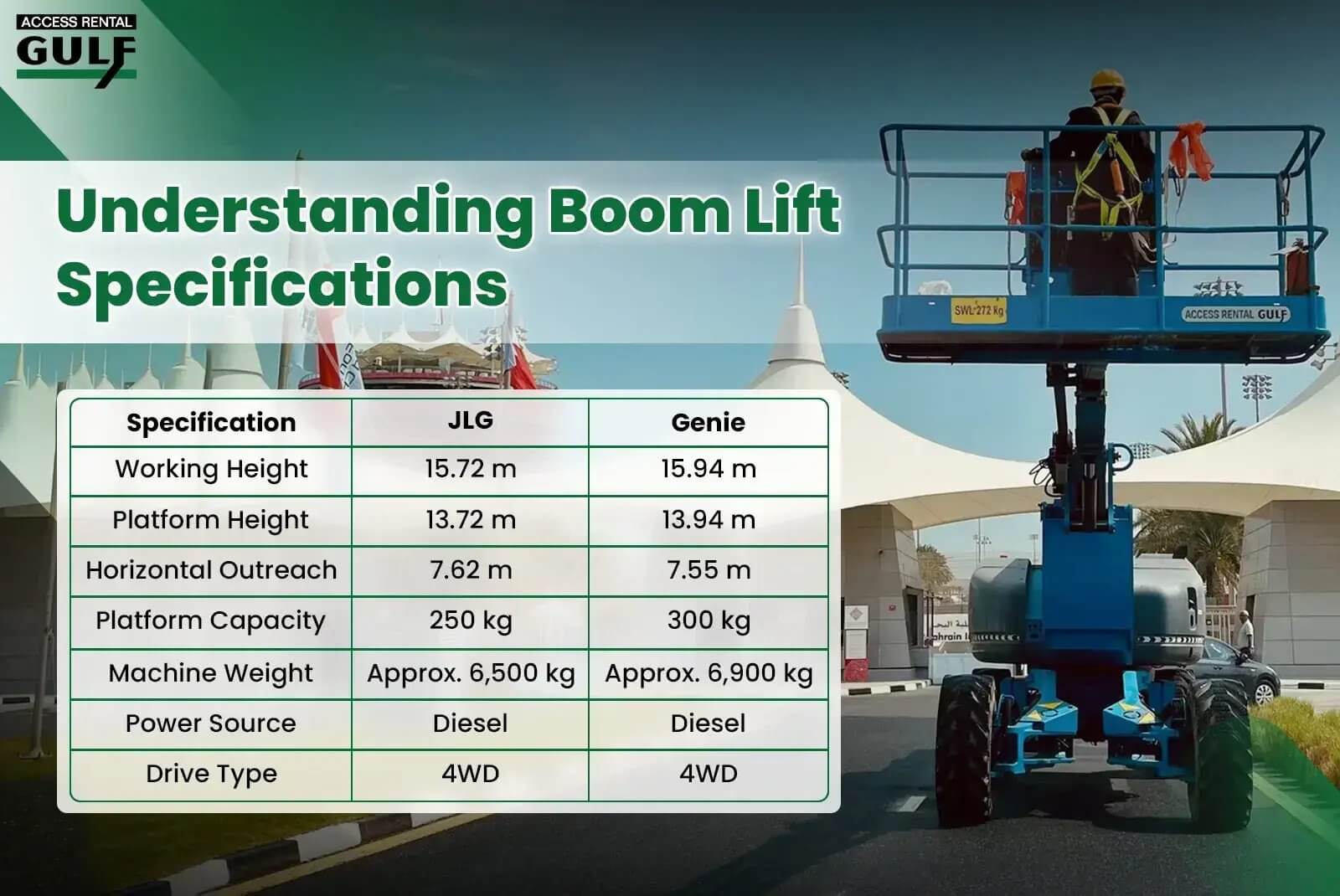
A machine’s boom lift specification sheet typically includes the following key data points:
● Platform height: The maximum height the platform floor can reach.
● Working height: Platform height plus an average operator’s reach (usually platform height + 2m).
● Horizontal outreach: How far the platform can extend sideways from the base.
● Platform capacity: The maximum combined weight of operators, tools, and materials.
● Machine weight: Important for transport planning and for assessing ground-bearing pressure.
● Overall dimensions: Stowed length, width, and height, which determine whether the unit can pass through doorways or narrow site access points.
● Power source: Diesel, electric, or bi-energy (dual power).
● Drive type: Two-wheel, four-wheel, or all-wheel drive, and whether the chassis is wheeled, crawler-tracked, or truck-mounted.
Comparing these specifications against your project’s actual site conditions, not just the maximum height needed, is key to selecting the right machine the first time.
Boom Lift Manual & Documentation
Every boom lift should be operated with reference to its boom lift manual, which includes model-specific load charts, control layouts, and maintenance schedules. Operators should never rely on general boom lift knowledge alone; always confirm the specific model’s manual for load limits, especially when outreach changes the maximum safe capacity.
Boom Lift CAD Blocks for Planning & Design
For architects, site planners, and engineers preparing site logistics or access studies, a boom lift CAD block is a useful reference tool for visualizing machine footprint, swing radius, and clearance requirements during the design and planning stage of a project. Our team can advise on the dimensions of specific models to support your site planning drawings.
Boom Lift Service & Repair
Routine boom lift service is essential to keep a machine safe and minimize downtime. A typical maintenance schedule includes:
● Daily pre-use inspections (see our Safety, Training & Certification Guide for a full checklist).
● Scheduled hydraulic system checks, including the boom lift cylinder and hoses.
● Periodic structural inspection of boom sections and the platform.
● Battery or engine servicing depending on power type.
● Full manufacturer-recommended servicing at set operating-hour intervals.
For boom lift repair, always use qualified technicians familiar with the specific manufacturer’s requirements; improper repairs to hydraulic or structural components can compromise the safety of the entire machine.
Choosing the Right Platform: Standard vs Boom Lift with Forks
Standard boom lift platforms are designed purely for personnel access, but a boom lift with forks configuration allows limited material handling from the same machine. This can be useful on sites where combined access and light lifting tasks are required, though it is not a substitute for a dedicated material-handling machine for heavier lifting tasks.
Technical Support Across the GCC
Access Rental Gulf’s technical team supports customers across the UAE, Saudi Arabia, Qatar, and Bahrain with specification guidance, maintenance scheduling, and genuine parts sourcing for JLG, Genie, and Skyjack machines.
Speak to Our Technical Team
Contact us for detailed specification sheets, parts enquiries, or servicing support.
● Website: Access Rental Gulf
● Email: marketing@accessrental-gulf.com
● UAE: 971 4340 4573
● Saudi Arabia: 966 1380 81527
● Bahrain: 973 1784 0787
● Qatar: 974 4039 9522
FAQs
What information is included in a boom lift specification sheet?
A specification sheet typically includes platform height, working height, horizontal outreach, platform capacity, machine weight, dimensions, and power source.
What is the difference between platform height and working height?
Platform height is the height of the platform floor itself, while working height adds an average operator’s reach, usually around two metres more.
Why does boom lift weight matter?
Machine weight affects transport planning, ground-bearing capacity, and whether the unit is suitable for rooftop or suspended-floor work.
What is boom lift capacity?
Boom lift capacity is the maximum combined weight of operators, tools, and materials the platform can safely carry, which may decrease as outreach increases.
What is a boom lift cylinder?
The boom lift cylinder is the hydraulic component responsible for raising, extending, and articulating the boom, and it requires regular inspection for leaks or wear.
How should a boom lift battery be maintained?
Electric boom lift batteries should be fully charged after each use, checked for fluid levels where applicable, and professionally inspected on a routine schedule.
Where can I find a boom lift manual for a specific model?
The manufacturer-issued manual should always accompany the machine; Access Rental Gulf can also help source model-specific documentation for equipment we supply.
What is a boom lift CAD block used for?
Architects and site planners use a CAD block to visualize a machine’s footprint and clearance requirements during project design and logistics planning.
How often should a boom lift be serviced?
Boom lifts require daily pre-use inspections plus scheduled servicing at manufacturer-recommended operating-hour intervals, covering hydraulic, structural, and power systems.
Who should carry out boom lift repairs?
Boom lift repairs should always be carried out by qualified technicians familiar with the specific manufacturer’s requirements, particularly for hydraulic and structural components.