
A boom lift is one of the most useful pieces of access equipment on any site. Still, it must always be operated by a trained, certified operator following a proper safety process. This guide covers boom lift certification, licensing requirements, common hazards, and the checklists every operator across the UAE, Saudi Arabia, Qatar, and Bahrain should follow before starting work.
For a full overview of boom lift types and uses, see our pillar guide: The Complete Guide to Boom Lifts.
Why Boom Lift Certification Matters
Operating a boom lift without proper training puts the operator, other site workers, and the public at risk. A boom lift operator license demonstrates that the person controlling the machine understands its controls, limitations, and the correct emergency procedures. Across the GCC, IPAF (International Powered Access Federation) certification is the internationally recognized standard accepted on the vast majority of construction and industrial sites.
Access Rental Gulf operates a licensed IPAF training centre, so customers who rent or buy equipment from us can also get their operators properly certified in the same process.
How to Get a Boom Lift Licence
Getting a boom lift licence through an IPAF-accredited course typically involves:
1. Theory training: Covering machine types, controls, pre-use inspections, and site hazards.
2. Practical training: Hands-on operation under supervision, covering set-up, manoeuvring, and safe shut-down.
3. Assessment: A combined theory and practical test to confirm competence.
4. Certification: Successful candidates receive an IPAF PAL Card, valid for two years, which is widely recognised as proof of a boom lift certification across the region.
Operators should renew their certification before it expires. They should never operate a machine category they have not been specifically trained and assessed on; for example, a scissor lift certification does not automatically cover boom lift operation.
Boom and Scissor Lift Training: What’s Covered
Many training providers, including Access Rental Gulf, offer combined boom and scissor lift training because both machine categories fall under the broader MEWP classification. However, the specific controls and hazards differ. A thorough course will typically cover both categories separately, ensuring operators understand the distinct handling characteristics of each machine type rather than assuming skills transfer automatically between them.
Boom Lift Safety Checklist
Before every shift, operators should complete a boom lift safety checklist, including:
● Visual inspection of the boom, platform, and chassis for damage.
● Checking hydraulic hoses and cylinders for leaks.
● Testing all controls, including the emergency stop and descent system.
● Confirming guardrails and gates are secure and functioning.
● Checking tyre condition and outrigger operation.
● Verifying the ground/work area is suitable, flat, stable, and free of overhead hazards.
● Confirming the operator’s harness and lanyard are correctly fitted.
● Checking that the machine’s rated capacity is not exceeded by workers, tools, and materials combined.
Skipping this checklist, even for a short job, significantly increases the risk of an incident.
Common Boom Lift Hazards
Comprehending common boom lift hazards is central to preventing incidents on site:
● Overhead obstructions: Power lines, structural beams, and pipework can cause serious injury if the platform contacts them. Read our detailed guide on Avoiding Overhead Crushing.
● Ground instability: Soft, uneven, or sloped ground can cause tip-overs. See our guide on Ground Conditions for MEWPs.
● Overloading the platform: Exceeding the rated capacity affects stability and control.
● Improper loading/unloading: See our guidance on Loading & Unloading MEWPs.
● Falls from height: Incorrect use of harnesses or leaning over guardrails.
● Electrocution: Contact with live overhead cables, particularly relevant for electrical installation and construction sites.
● Entrapment: The platform becoming trapped between the boom and a fixed structure.
Understanding Boom Lift Accidents
Most boom lift accidents trace back to a small number of root causes: inadequate training, skipped pre-use inspections, overloading, poor ground assessment, or working too close to overhead hazards. A properly conducted boom lift risk assessment before each job, reviewing the specific site, task, and environmental conditions, is one of the most effective ways to prevent these incidents. Risk assessments should be documented, reviewed by a competent person, and communicated clearly to the operator and any ground personnel before work begins.
Exiting a Boom Lift at Height
Certain maintenance and inspection tasks require an operator to step out of the platform at height, for example, onto a fixed structure. This is one of the higher-risk activities associated with boom lift operation and should only ever be carried out following a specific method statement and appropriate fall protection. We cover this in detail in our guide on Exiting a MEWP at Height.
The Role of Ground Personnel in Boom Lift Safety
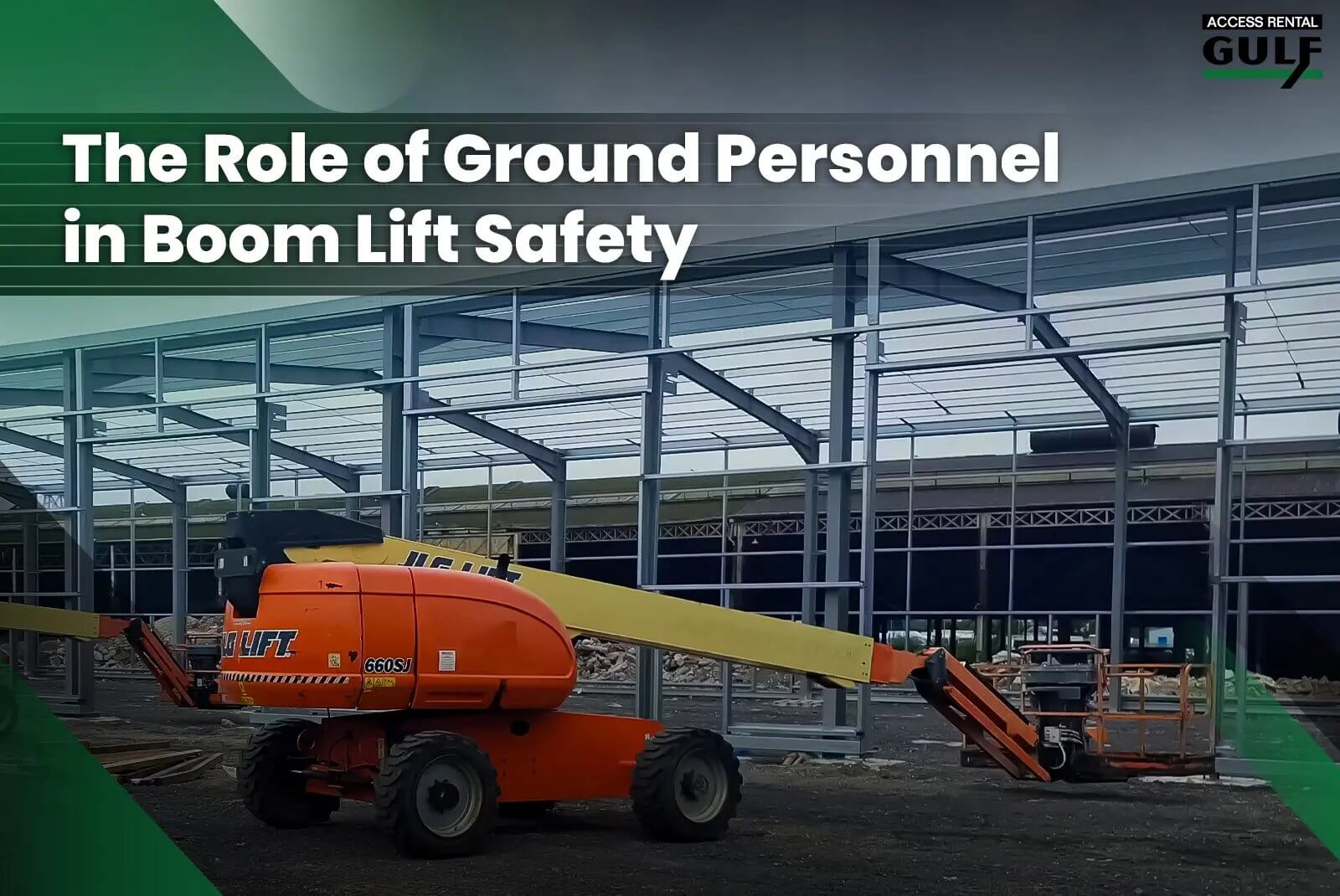
Safe boom lift operation is not just about the person on the platform. Ground personnel play an important supporting role by:
● Keeping the surrounding area clear of pedestrians, vehicles, and unrelated equipment.
● Watching for hazards the operator cannot see from the platform, such as approaching vehicles or changing ground conditions.
● Knowing how to operate the ground-level emergency controls in case the platform operator becomes unable to do so.
● Communicating clearly with the operator using agreed signals or radio contact, especially in noisy environments.
Sites that treat boom lift safety as a team responsibility, rather than solely the operator’s, consistently see fewer near-misses and incidents.
Building a Site-Wide Boom Lift Safety Culture
Beyond individual checklists and certifications, the safest sites build boom lift safety into their broader site culture through:
● Toolbox talks before major boom lift tasks, covering the specific risks of that day’s work.
● Visible reporting channels for near-misses, so small issues are addressed before they become serious incidents.
● Regular refresher training, not just initial certification, to keep skills and awareness current.
● Clear supervision structures, ensuring a competent person is always available to answer questions or authorize higher-risk tasks such as exiting a platform at height.
Access Rental Gulf’s training and technical teams are available to support these site-wide practices, not just individual operator certification, across projects in the UAE, Saudi Arabia, Qatar, and Bahrain.
Weather & Environmental Safety Considerations
Boom lift operation across the Gulf also needs to account for local environmental conditions:
● High wind speeds: Boom lifts have manufacturer-specified maximum wind ratings, and operation should stop if these are exceeded, particularly at height.
● Extreme heat: Operators should be monitored for heat stress during summer months, and machine components such as batteries and hydraulic fluid should be checked more frequently.
● Dust and sand: Reduced visibility and increased component wear both need to be factored into daily inspections and task planning.
Building these environmental checks into daily risk assessments is a standard part of safe boom lift practice across our region.
Training Availability Across the GCC
Access Rental Gulf’s IPAF training centre supports customers across the UAE, and our regional network extends training coordination support to projects in Saudi Arabia, Qatar, and Bahrain as well. Whether you are certifying a single new operator or an entire site team, our training team can advise on the right course structure for your business.
Book Training or Ask a Safety Question
Contact our team to book an IPAF course or discuss safety requirements for your project.
● Website: Access Rental Gulf
● Email: marketing@accessrental-gulf.com
● UAE: +971 4340 4573
● Saudi Arabia: +966 1380 81527
● Bahrain: +973 1784 0787
● Qatar: +974 4039 9522
FAQs
Do I need a licence to operate a boom lift?
Yes, operators should hold a valid IPAF certification or recognised equivalent before operating a boom lift on any commercial site.
How long is an IPAF boom lift certification valid?
An IPAF PAL Card is typically valid for two years, after which operators must renew their certification.
What is included in boom lift operator training?
Training typically includes theory on machine types and hazards, practical hands-on operation, and a combined assessment before certification is issued.
What should be on a boom lift safety checklist?
A safety checklist should cover visual inspection, control testing, guardrail security, ground suitability, and confirming the platform’s rated capacity is not exceeded.
What causes most boom lift accidents?
Most incidents stem from inadequate training, skipped inspections, overloading, poor ground assessment, or contact with overhead hazards.
What is a boom lift risk assessment?
A risk assessment is a documented review of the site, task, and environmental conditions carried out before work begins, aimed at identifying and controlling hazards specific to that job.
Is boom lift training different from scissor lift training?
Yes, while both fall under MEWP training, the controls, hazards, and handling characteristics differ, so operators should be specifically trained and assessed on the machine type they will use.
Can I get IPAF training through Access Rental Gulf?
Yes, Access Rental Gulf operates a licensed IPAF training centre offering full operator certification.
What should I do if I need to exit a boom lift at height?
Exiting a platform at height should only be done following a specific method statement and with appropriate fall protection in place, never informally.
Does Access Rental Gulf provide safety guidance alongside rental equipment?
Yes, our team provides safety guidance, checklists, and access to IPAF training alongside our rental and sales services across the UAE, Saudi Arabia, Qatar, and Bahrain.