
Both telescopic and articulated manlifts fall under the boom lift category, and both can lift a worker higher and farther than a scissor lift. The way they get there is fundamentally different, and that difference often matters more than the headline height figure when choosing for a specific site.
For the broader category breakdown, see our pillar guide: The Complete Guide to Manlifts.
The Core Difference
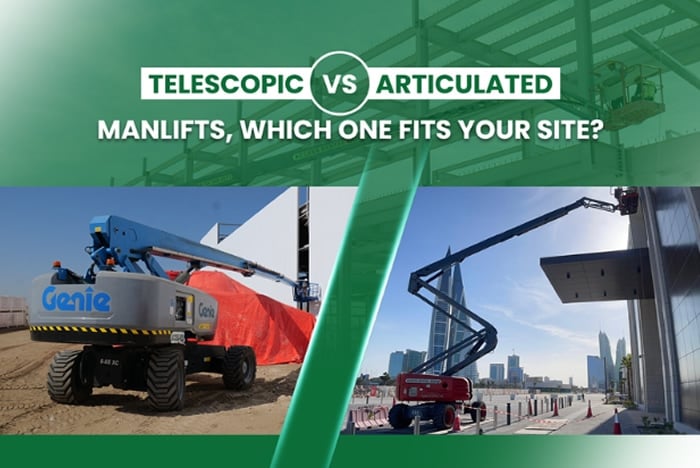
A telescopic manlift extends its boom in a single straight line, like an expanding pole, which suits height and horizontal reach along a direct path. An articulated manlift has jointed sections that bend at several points, allowing the platform to move up and over obstacles rather than only along a straight path.
| Feature | Telescopic Manlift | Articulated Manlift |
| Also known as | Straight boom lift | Knuckle boom lift |
| Boom design | Single straight extending boom | Multiple jointed boom sections |
| Main advantage | Height and horizontal reach along a straight line | Flexibility around obstacles |
| Movement style | Upward and outward in a straight line | Up, over and around obstacles |
| Best for | Open areas with clear access paths | Congested areas with structures or obstacles |
| Outreach | Often greater straight-line outreach (varies by model) | Better positioning flexibility |
| Site requirement | Needs a clear working path | Works where direct access is blocked |
| Common industries | Infrastructure, high-rise construction, steel work | Maintenance, MEP, facilities, industrial work |
When Should I Choose a Telescopic Manlift?
Choose telescopic when you need height and straight-line outreach with a largely unobstructed path between the machine and the work point. Because the boom extends in one continuous line, telescopic models often provide more horizontal outreach relative to platform height than articulated models of a similar size, although exact figures vary by model.
| Requirement | Why Telescopic Works | Example Applications |
| Substantial height | Straight boom provides vertical reach | High-rise construction |
| Long horizontal outreach | Direct extension reaches distant work points | Bridge and infrastructure projects |
| Open working area | Fewer obstacle adjustments needed | New construction sites |
| Clear access path | Machine can position directly below the target | Steel installation and façade work |
| Large outdoor projects | Often used for heavy-duty external operation | Industrial sites and airports |
Common scenarios include open construction sites, infrastructure projects, tall façade work with a clear approach, and any job where the straight-line distance from a safe machine position to the work point is the limiting factor.
When Should I Choose an Articulated Manlift?
Choose articulated when the path to the work area is not a straight line, for example, when scaffolding, existing structure, piping, or other equipment sits between where the machine can stand and where the platform needs to end up. The jointed sections let the platform flex up, over, and around these obstacles in a way a straight extension cannot.
| Requirement | Why Articulated Works | Example Applications |
| Obstacles between machine and work area | Jointed boom moves around barriers | Building maintenance |
| Limited positioning space | Can reduce machine repositioning | Indoor industrial facilities |
| Complex structures | Allows up-and-over movement | MEP installation |
| Congested work areas | Better manoeuvrability | Commercial buildings |
| Existing buildings | Works around pipes, equipment and structures | Inspection and repair work |
Common scenarios include maintenance and inspection around existing structures, MEP installation in congested mechanical rooms, and any site where the work point is reachable but not along a direct line from a safe machine position.
Does an Articulated Manlift Sacrifice Height for Flexibility?
Often, though it depends on the model, many articulated machines are offered with lower maximum heights than telescopic units of a comparable size, because the jointed sections add weight and mechanical complexity. Large articulated models do exist, however, so compare individual specifications rather than relying on the type alone. If a job genuinely needs both maximum height and the ability to work around obstacles, it may be better served by two different machines for different phases than by one machine doing both adequately.
Footprint and Site Manoeuvrability
Once positioned, articulated manlifts often need less clearance to work around obstacles, because the jointed arm compensates for them rather than requiring the whole machine to move. On congested sites, this can mean fewer repositions over the course of a job. A telescopic boom may need to be relocated each time the straight-line path to the next work point is blocked. The actual footprint depends on the model, so check dimensions and ground requirements in the specification. Our manlift specifications guide explains how to read them.
Operator Controls and Training
IPAF groups boom lifts under mobile boom (3b) and static boom (1b) categories, and telescopic and articulated machines are generally both covered by the same mobile boom category. Even so, joystick response and boom movement differ between machines, so operators should be familiarised with the specific model they will run rather than assuming skills transfer automatically. For a full breakdown of certification, see manlift operator training and certification.
Mixed Fleets: Using Both on the Same Project
Many contractors do not pick one type for an entire project. They use telescopic booms for open, high-reach phases and switch to articulated booms for tighter, obstacle-heavy sections of the same site. This is common on large construction projects where early-stage work is largely open (favouring telescopic) and later MEP and finishing work happens around a completed structure (favouring articulated).
A Common Selection Error: Choosing on Height Alone
A common selection error is choosing a boom lift purely on its maximum height specification without accounting for the obstacles between the ground and the work point. A taller telescopic boom is no help if it cannot get a clear path to the target. In that scenario, a shorter articulated model that can actually reach the point is the better choice, whatever the spec sheet’s headline figure says.
FAQs
What is the main difference between a telescopic and an articulated boom manlift?
A telescopic manlift extends in a straight line for reach, while an articulated manlift has jointed sections that bend, allowing it to move up and over obstacles.
Which is better for tight, obstacle-filled spaces?
An articulated manlift is generally better suited because its jointed boom can work around structures more easily than a straight extension.
Does an articulated manlift sacrifice height for flexibility?
Often, but not always. Many articulated models have lower maximum heights than telescopic machines of a similar size, though this varies by model, so compare specifications.
Which type needs less repositioning on site?
On congested sites, articulated booms often need fewer repositionings because the arm works around obstacles, but this depends on the machine and the layout.
My site has both open yard space and tight indoor access. Which type covers both?
Neither type alone always covers both. Many contractors run a mixed fleet, using telescopic booms for open, high-reach work and articulated booms for obstacle-heavy sections.
Do telescopic and articulated manlifts use the same operator controls?
Controls and machine response differ between models. Both are generally covered by the same IPAF mobile boom category, but operators should be familiarised with the specific machine before use.
Which type is more common in inspection and maintenance versus new-build work?
Articulated booms are often used for inspection, maintenance, and MEP work around existing structures, while telescopic booms are often used on new-build sites with open reach paths.
What is a common mistake when choosing between the two?
Choosing based on maximum height alone without considering the obstacles between the ground and the work area.
Is horizontal outreach different between the two?
Telescopic manlifts often offer more horizontal outreach relative to platform height, while articulated manlifts trade some of that for up-and-over movement. Exact outreach varies by model.
Can Access Rental Gulf help me choose between telescopic and articulated manlifts?
Yes. Our team can review your site layout and access points and suggest a telescopic, articulated, or mixed approach. Browse our manlift rental range to get started.
Contact Us
Website: Access Rental Gulf
Email: marketing@accessrental-gulf.com
UAE: +971 4340 4573
Saudi Arabia: +966 1380 81527
Bahrain: +973 1784 0787
Qatar: +974 4039 9522